
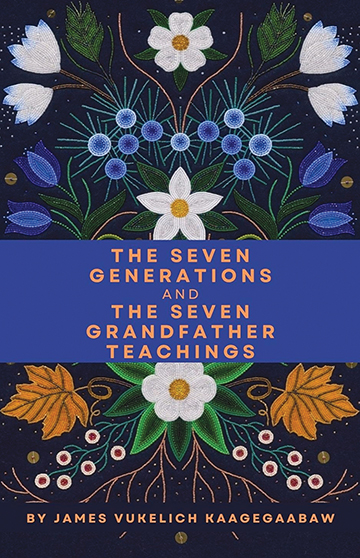
Review by Deborah Locke
A book about the Ojibwe language with large type and about the length of an essay sat on my book pile for a while. I figured I’d get to it one of these days, presuming it was for young readers judging from its type size and brevity.
Instead, “The Seven Generations and The Seven Grandfather Teachings” (self-published, 2023) will cast light on ancient wisdom for readers of any age, all the while teaching the Ojibwe language. Author James Vukelich Kaagegaabaw (Turtle Mountain descendant) is well practiced at explaining the heart of the Ojibwe language. You may have viewed his “Ojibwe Word of the Day” series on YouTube, FaceBook or Instagram, which has amassed thousands of followers. His sonorous, rich voice is ideal for instruction.
Of course, the book lacks sound, but it excels as an introduction to Ojibwe expression. I have listened to native Ojibwe speakers throughout my life starting with my grandfather, Vincent Lemieux. I never recognized nor comprehended the amazing precision of the language, or knew what a gift it is until now.
Grandparents – family connections generally – figure largely in Vukelich’s story of the way Ojibwe was handed down by a people who well knew the land and their place on it. He wrote that when we hear a word like Nookomis (my grandmother), we hear a sound “created by a person who knew this land back when it was covered by ice a mile high, before Gichi-gami, the Great Lake, Lake Superior, existed. When we use the old words, we are using words that were spoken by someone who saw woolly mammoths, giant Mooz (moose) and Misamik (giant beaver).”
Vukelich said that certain words contain seeds to important questions like why am I here on this earth? He explicates the language, breaking words into small parts for an understanding of their meaning. The language offers a “Great Law” or a “Sacred Law” that helps speakers live in peace and balance. He cites the Iroquois tradition of making every decision in life with a thought to the action’s impact on seven generations to come. The Seven Generations concept of connectivity can be found in indigenous communities across North America. For example, Black Elk (Oglala Lakota; 1863-1950) referred to Seven Generations.
The seven generation teachings, known as Gichi-dibaakonigwewinan, are truth, humility, respect, love, bravery, courage, honesty, and wisdom. The chapter on honesty states that just speaking the truth isn’t enough, it’s also imperative to live honesty, align your words with action, and lead a wholistic life. Vukelich asks why would we use a sacred gift from the Creator, the Ojibwe language, to deceive others? The language shows that a consequence of deceit is disorder. Only those not in balance will lie.
He wrote:
“A person with peace, balance, and order in their life will act with honesty, virtue, and righteousness. It will be a natural reflection in their life. The words we say are not so important as the deeds we do. We must align our actions, thoughts, and words in order to lead a holistic life – a holy life.”
He closes by pointing out that when we change and improve ourselves, we change and improve those who went before us and those to come. History including that of our own families points to American Indian survivors of colonization, boarding schools, the lack of liberty and civil rights in our very homeland. Our relatives who were without any tools for dealing with that pain may still be healed through our interconnections with them. “I can still heal them,” Vukelich wrote. “We are still writing our ancestors’ stories.”
The book delivers a nudge to learn more native language to find peace and heal the past. Perhaps many of us missed the opportunity to learn our native languages when our grandparents were alive and available. “The Seven Generations” shows that the grandparents are still here speaking to and through us, still a part of us.