

By Lee Egerstrom
High school students thinking about going to college after graduation should explore Minnesota’s many options for earning college credits along with their high school diplomas.
Advocates of dual credit programs stress that earning no-cost college credits while in high school has saved students and families millions of dollars over the years. It has also given high school students “a taste,” as two University of Minnesota professors call it, of what college is like for future years.
“We are reaching out to American Indian, people of color and to families that do not have strong financial positions. College is possible,” said Brook LaFloe (Turtle Mountain Ojibwe), vice president of People for PSEO, an advocacy group promoting Minnesota’s Post-Secondary Enrollment Options program (PSEO).
PSEO dual enrollments are one of four programs available to motivated high school students. Another program is College in the Schools (CIS) that increasing numbers of high schools offer students. A few school districts have qualified high schools as part of the Swiss-based International Baccalaureate (IB) program, and far more Minnesota high schools offer nationally organized Advanced Placement (AP) courses.
All can lead to receiving college credit for work while in high school, at no cost to students or parents.
If all this is new to you, as it usually is for oldest child students and their parents, don’t wait for school to begin before exploring programs, advocates say. Consult school counselors, knowledgeable teachers and people in your community who have duel credit program experiences.
Students who want to “taste test” what college is like should engage their parents in the process of learning which programs are convenient to where they live and go to school, and whether they possess the talents and ability to take on a bigger academic challenge, LaFloe said.
This need for students and parents to explore together was also stressed by her mother, Janice LaFloe, founder of the Montessori American Indian Childcare Center in St. Paul.
“As a parent, I believe it is our job to support, love, push and fight for every opportunity for our children that we can,” she said.
Links to education sites explaining these programs are offered below this article. First, however, take a look at some of the people who have utilized these programs.
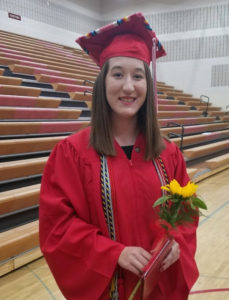
Jaidyn Probst, from the Lower Sioux Indian Community, will leave home later this month to start college at Harvard University. She is believed to be the first LSIC member to attend the prestigious university.
This achievement didn’t just happen. While a high school student, Probst acquired 40 dual college and high school credits the past two years by taking online college courses at the University of Minnesota’s Crookston and Morris campuses.
That didn’t deprive her of a high school experience. Probst served the past year as president of the Redwood Valley High School National Honor Society and of the United National Indian and Tribal Youth (UNITY) group at nearby Redwood Falls. She was captain of the track team.
In other roles of community leadership, Probst served as a youth ambassador for the Lower Sioux Indian Community. Within the past year she was appointed to the Young Women’s Initiative Cabinet of Minnesota and to the National Young Women’s Council.
Brook LaFloe, whose family are members of the Turtle Mountain Band of Chippewa in North Dakota, took a slightly different path to dual credits and multiple accomplishments. She took College in the Schools (CIS) classes at Johnson High School in St. Paul. Like most metro area high school, Johnson made these dual classes available and that kept her at school to participate in activities.
“I was a three sport student at Johnson (volleyball, basketball and track). I needed to be at school after classes and not running to a campus somewhere,” she said, as PSOE students often do to nearby colleges.
LaFloe went to Macalester College in St. Paul after graduating Johnson in 2011. She continued to play basketball and volleyball there for two years, then transferred to Tulane University in New Orleans and played basketball at the Division I (NCAA) level.
She graduated with a Bachelor’s degree in neuroscience and anthropology. But she felt a calling from her mother Janice’s work in St. Paul with early childhood education, the American Indian Family Center and St. Paul Indian Education Program. Brook then went to Loyola University Maryland for a Master’s in education.
“My full-time job is at the Women’s Foundation of Minnesota,” she said. She is the Reatha Clark King Fellow and Young Women’s Initiative Program Manager.
The president and founder of People for PSOE, Aaliyah Hodge, used PSOE dual credits to work a fast pace. Hodge took dual courses at the University of Minnesota Twin Cities while a student at St. Louis Park Senior High School. She earned a Bachelor’s degree at age 19 and a Master of Public Policy degree from the University’s Humphrey School at age 21.
Her current full-time position is the Charter School Authorizing Program coordinator at the University of St. Thomas. And, she is a senior consultant for Center for School Change, an advocacy and research organization from which People for PSOE was born.
The PSOE group has three goals, she said. One is to promote PSOE among families, students, educators and the general public. Another is to advocate “the refinement, expansion and improvement” of the program with information for legislators and policy-makers. With the third focus, the group works to “encourage greater equity and access to PSOE for students throughout Minnesota” by working with higher education institutions and secondary schools, Hodge said.
Online resources for duel credit programs
- A side-by-side table comparing Concurrent Enrollment, Advanced Placement, Post-Secondary Enrollment Options, and International Baccalaureate programs can be found at: http://ccaps.umn.edu/documents/DCP/CE-AP-PSEO-IB-Comparison.pdf.
- UofMN CIS information is at: https://ccaps.umn.edu/college-in-the-schools.
- A helpful explanation of CIS benefits, titled “A Taste of College” can be found at: https://cla.umn.edu/spanish-portuguese/news-events/story/taste-college.
- PSEO information is available from the Minnesota State Colleges and Universities System at: www.minnstate.edu/admissions/pseo/pseo_faq.html.
- The MN Dept.of Ed provides a list of participating colleges and universities with PSOE dual credit programs at: https://education.mn.gov/MDE/fam/dual/pseo/ 040787. (It shows Fond du Lac Tribal and Community College, Leech Lake Tribal College, Red Lake Nation College and White Earth Tribal and Community College among them.)
- Information about Advanced Placement courses, including participating Minnesota schools, can be found at: https://education.mn.gov/MDE/fam/dual/AP.
- The International Baccalaureate program organization in Switzerland currently shows 20 Minnesota schools in its diploma programs, 18 of which are in the Twin Cities metro area. The school listing can be found at: https://www.ibo.org/programmes/find-an-ib-school.