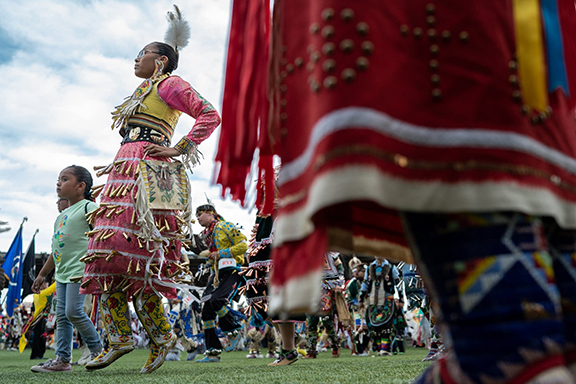
By Dan Gunderson/MPR News
When Labor Day weekend rolls around this year, Brenda Child (Red Lake Ojibwe) will miss an event that’s been a part of her life for as long as she can remember.
She lives most of the year in the Twin Cities now – she’s a professor at the University of Minnesota – but grew up on the Red Lake Nation, with fond memories of powwows. She’s even written a children’s picture book about powwows.
“My favorite powwow of the year comes Labor Day weekend, when there is a singing contest up in Ponemah, Minn.,” she said. “Every year, I take my children to Ponemah and we sit there by the lake and we listen to the music. I think I’ll be really sad on Labor Day weekend.”
For Child, powwows are energizing and contemplative. They’re about music, dancing, food, hours visiting with family and friends – and time thinking about relatives no longer at the powwow.
“My mother or my grandmother or my uncles who’ve passed on, so it’s not just something that I share with my children, but it’s a time to really be immersed in Ojibwe culture,” she said.
Many people across the state spend months preparing for powwow season, which is traditionally happening right about now. But COVID-19 has upended those plans: As states and tribal nations continue their fight against the spread of the coronavirus, many powwows this year have been canceled, leaving people pining for the community, the family and the celebration of Native culture that powwows bring.
“It’s something really huge for our people when we have a powwow, because the gathering and the good feelings that happen at those powwows is something you really can’t describe,” said Gary “Rez Dawg” Jourdain, who traveled the powwow circuit when he was younger with the popular Red Lake drum group Eyabay.
Jourdain said he’s made a lot of friends across the United States and Canada on the powwow trail, and now sees many of them only during powwow season.
There have been a few small powwows held across Indian Country this summer, but most are canceled, as tribal governments implement policies to limit the spread of COVID-19. Instead, this summer, some performers are getting creative – and gathering virtually.
Recently, 10 singers from Eyabay gathered around a drum in Red Lake to perform live on the Facebook group Social Distance Powwow. Dancers from across the country are also posting videos online, often dancing alone on videos posted to the social media site.
“It’s pretty cool, but nothing will ever replace the feeling of sitting in that arena with everyone and just watching it live,” said Jourdain.
People have also had to get creative with another important part of powwow season: The food.
“What we’re seeing around here during this lockdown time is [that] the people [who] had food stands at our powwows are setting up in their yard now,” Jourdain said. “They’re like, ‘Hey, you know, we didn’t get to powwow this year, but our food stand is open this weekend, come on out and enjoy some fair food.’”
Powwow history still being written
The powwows of today were shaped by U.S. government suppression. In the early 1920s, federal legislation known as the Dance Order prohibited American Indian dances. So, Child said, the people adapted.
“One of our strategies to circumvent these policies of the government was to start calling our celebration a Fourth of July celebration, and plant flags and celebrate veterans,” she said.
Flags, flag songs and songs honoring veterans are still an important part of powwows. So are the songs and dances created by ancestors of past generations – including the more recent jingle dress healing dance, which was born of the 1918 flu pandemic.
The powwow survived government suppression, Child said, and it will survive a pandemic. And while she misses the energy and the joy of powwow season, she’s relying on the many memories to carry her through this lonely summer.
“To me, if a powwow’s really good, it lasts until late at night. I often remember at Red Lake, being a kid with my uncle playing in his drum group and my mom and I dancing at the powwow, that there were nights that we didn’t go home. We would go home when the sun was coming up in the morning,” Child recalled.
Social media is filled with posts from people wishing they were at a now-canceled powwow somewhere in Indian Country. Jourdain said he thinks, when the pandemic threat eases, powwows will be bigger and better.
“If this is out of the way by next year, I’m sure you’re going to see record-breaking crowds at all the powwows that are going to start back up,” he said.
And maybe there will be a new song or dance – to mark the history of this pandemic.
Minnesota Public Radio News can be heard on MPR’s statewide radio network or online.
To learn more about Covid-19, see MDH.