

By Lee Egerstrom
The Minneapolis Federal Reserve Bank and its Center for Indian County Development (CICD) have turned up data showing what you may have suspected. Native Americans had fewer opportunities to work remotely during the COVID-19 pandemic.
Caryn Mohr, a writer and analyst at the CICD center, reviewed research in January with Matthew Gregg and Robert Maxim who recently conducted a study of Native American participation in what Mohr called “the remote work revolution.”
Gregg is a senior economist at the Minneapolis Fed and focuses on research for CICD. Maxim is a Brookings Institution researcher and a member of the Mashpee Wampanoag Tribe of Massachusetts.
They produced a report, “Native Americans are getting left behind in the remote work economy,” for Brookings, the Washington, D.C.-based think tank.
Much attention has been given to how American workers and employers adjusted to the COVID-19 pandemic. In general, the American workforce adjusted to the pandemic and continues to work remotely better than most experts had expected.
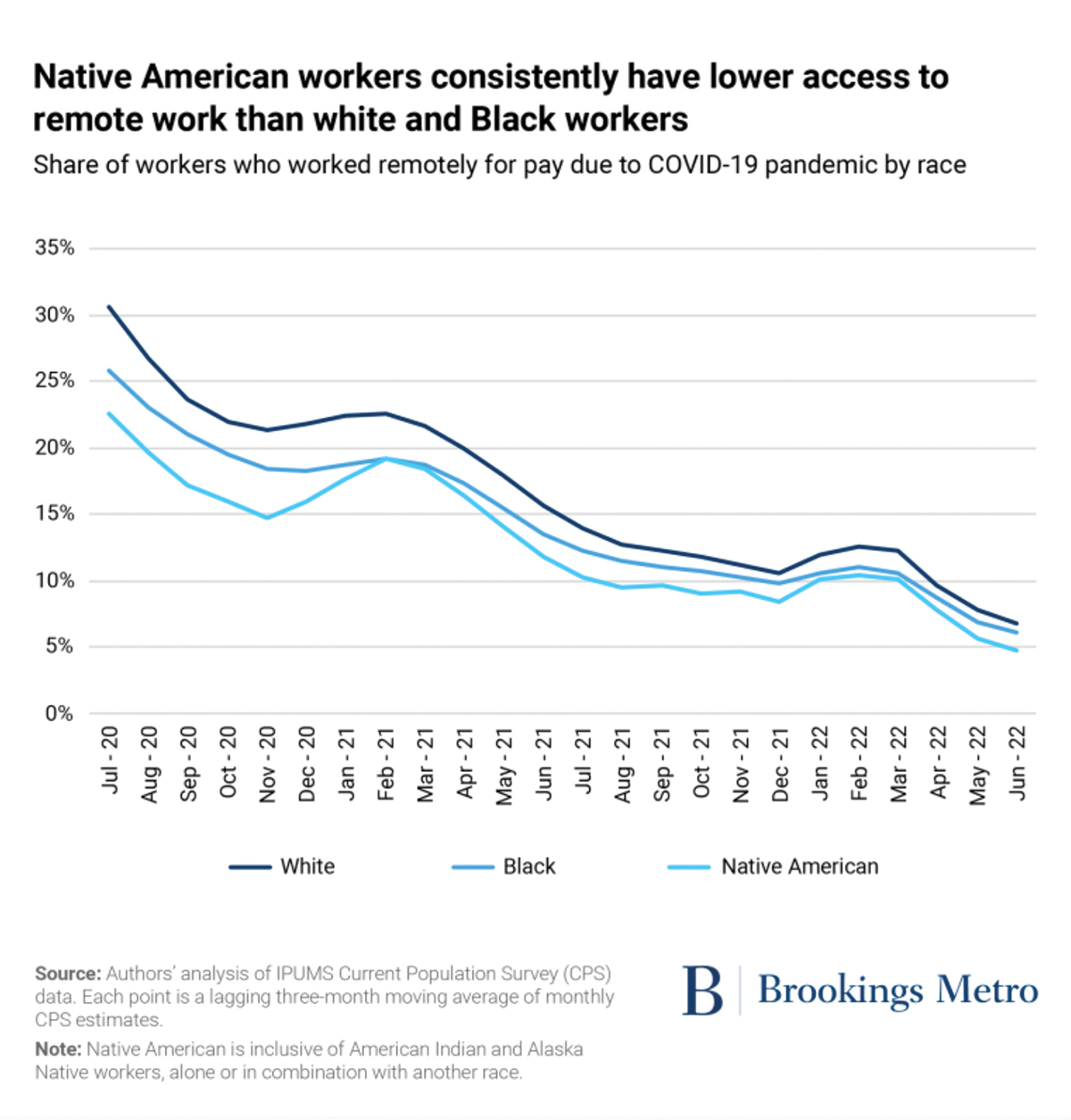
But that wasn’t the case for American Indian and Alaskan Native people, the researchers found. A peak in pandemic-related remote work occurred from May to July 2020, Census documents showed. During that time 31 percent of employed White workers were working from homes and away from central offices and business buildings. Only 23 percent of AIAN identified workers had that opportunity.
“I don’t think I anticipated the magnitude of the difference there,” Maxim said in the article Mohr prepared for the Minneapolis Fed.
The researchers found Native workers were less likely to work from home during the period of May 2020 to June 2022 where employment and the domestic economy were impacted by the pandemic.
One reason for the gap was occupational differences. About a quarter of the gap was the result of Native Americans being more inclined than the general public to be frontline workers in jobs that cannot be done from home.
Gregg cited another reason, the tribal digital divide, which he has studied at the Fed.
“Roughly speaking, access to fast, affordable Internet is scarce not only in Indian Country but even when compared to Internet access just outside Indian Country,” he said. “The size of the tribal digital divide is pretty substantial so it’s not hard to imagine how that could contribute to a remote work gap.”
Maxim went further, saying the lack of opportunities to work from home is a result of the lack of investment by government in tribal economies and Native workers.
“I think when you look at the geography of where Native people live it’s not a coincidence that many tribes and reservations are either at the periphery of metro areas or in nonmetro rural areas with less access to resources – digital infrastructure, employment opportunities, or otherwise.”
This, Maxim said, is a consequence of the federal government’s terminating reservations, disenrolling tribal citizens, and forcing Native people to move to urban areas. The latter often come with minimal skills training and employment opportunities.
“Even today when there are tribes being forced to put a disproportionate amount of resources into maintaining their land and sovereignty in the face of efforts to take it away, it leaves fewer resources to focus on economic and community development,” he said.
Gregg and Maxim stressed the need to invest in employment training and in building opportunities. This should be done at reservations, they noted, and it should be done in urban areas as well.
They specifically cited the American Indian Opportunities Industrialization Center in Minneapolis as an example of how to improve Native American workforce development.
“Scaling up Native American-led programs like these not only helps provide culturally appropriate services, but can also help job seekers to tap into broader networks of Native American workers and Native American-led employers,” they said.
The Gregg and Maxim report for Brookings is available at https://www.brookings.edu/research/native-americans-are-getting-left-behind-in-the-remote-work-economy.
Mohr’s report for the Minneapolis Fed is at https://www.minneapolisfed.org/article/2023/native-americans-have-fewer-opportunities-to-work-remotely