


By Lee Egerstrom
The Twin Cities have some of the most diverse local political leadership teams to be found anywhere in the United States and just got more diverse with Native American leaders in the mix.
Kelly Miller just won the District 7 seat on the Ramsey County Board of Commissioners representing Maplewood, North St. Paul and White Bear Lake. She is the chief program officer for the Interfaith Action of Greater St. Paul organization and previously was director of its Department of Indian Work.
Lucie Skjefte won an open seat of the Minneapolis School Board. She is the chair of the school district’s American Indian Parent Advisory Committee.
Both women are Anishinaabeg. Both come to office with significant background in service to the Native American community and the diverse general public of the Twin Cities. Neither had a typical way of taking on their new roles.
Miller, an enrolled member of the Mille Lacs Band of Ojibwe, survived a recount of votes in the November election to take the commissioner seat held by retiring Victoria Reinhardt. She held the seat since 1996.
The recount showed Miller actually won by 31 votes over Sarah K. Yang, of North St, Paul, who has extensive experience working within the Hmong community of Ramsey County and with various political leaders statewide.
Miller was declared the winner by 28 votes on election night. That was close enough to trigger a recount of that election and other close calls in Ramsey County.
Both candidates continue the trend of women gaining unusual dominance in local elections in St. Paul and Ramsey County.
“Look at the (Ramsey County) board, and look at the St., Paul City Council,” she told The Circle after the recount. “Women aren’t held back. And this does add a Native voice to governance and policy making in Ramsey County.”
All seven members of the St. Paul City Council are women and reflect the ethnic diversity within the city’s population. Rafael Ortega, who became the first Latino elected to a Minnesota county commissioner position in 1994, is the only male on the Ramsey County board.
Skjefte, meanwhile, was elected to the Minneapolis school board without going to voters within the city of Minneapolis. A member of the Red Lake Nation, she won a coin toss at a school board meeting to succeed Faheema Feerayarre, a member who resigned in September too late to put that open seat on the November election ballot.
Fatimah Hussein and Skjefte were among interested people seeking the open school board seat. Both got 4 votes in a deadlock among board members. Skjefte prevailed with a flip of a coin.
An Indigenous graphics designer and director of the Mni Sota Fund community development organization for Native people, she told Minneapolis media in November that she wants to promote language immersion programs within Minneapolis schools.

“It’s a beautiful way to maintain our identity,” she said in a KSTP television report on Nov. 22.
While serving as chair of the American Indian Parent Advisory Committee, she was especially focused on the Anishinaabe Academy that she wants to expand. About 200 Native students take pre-K language immersion classes there with the option of continuing in higher grades, KSTP reported.
That work as a parent and from her “day job” with the Mni Sota Fund embody the concept of service to community. It also describes the record and example built over years across the river in St. Paul by new Ramsey County Commissioner Miller.
In an interview with The Circle, Miller said she “rose from the ground up” at Interfaith Action of Greater St. Paul working on emergency needs to heading its Department of Indian Works for the past five years before being named chief program officer this past summer.
Interfaith Action is the former St. Paul Council of Churches that began social service programs in 1952. It changed its named in 2014 to reflect the diversity of Ramsey County and the participating houses of worship that participate and support the group’s social service programs.
“We have been helping people in need, and Native American people and families, for nearly 75 years,” she said. What the participating groups and their volunteers do in St. Paul and Ramsey County “sometimes gets lost,” she said, as attention gets focused on “all the wonderful organizations on Franklin Avenue” providing parallel services in Minneapolis.
Needs are great for Indigenous people and the general public throughout America’s urban communities, she said.
In tabulations put together this past year for 2023 projects, Miller said Interfaith Action provided assistance and services to 5,037 people and 1,819 families in its East Metro communities.
The Department of Indian Work (DIW) programs were a big part of Interfaith Action’s overall activities. DIW programs served 4,540 individuals and 1,672 families.
Among its various programs, Interfaith Action’s 2023 Impact Report showed it provided 26,000 shelter bed nights for needy people and 57 families were moved from shelters to permanent, affordable housing.
It distributed 360,000 pounds of food to 2,271 people and 33,000 meals were served at day centers. The organization calculated 2,521 hours of volunteer work on its diverse activities that included American Indian Youth Enrichment programs.
The American Indian Youth Enrichment programs have after school and summer programs for Indigenous cultural, wellness and education activities. DIW describes the goal, “Through this work, American Indian youth gain a strong Indigenous identity, become advocates for their culture, and succeed in school.”
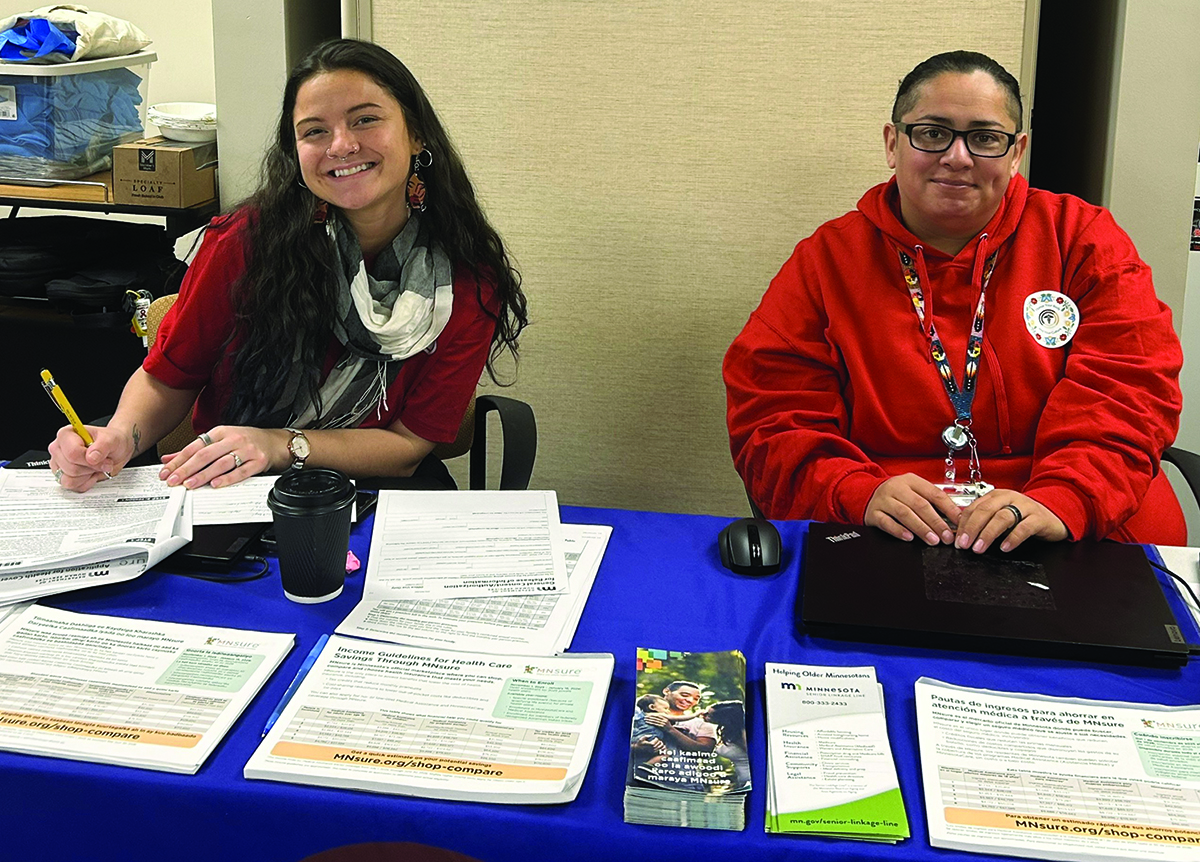
The DIW’s Emergency Services group provides a food shelf, clothing closet and referrals to employment, transportation, education and community resources available to aid American Indian families.
Its Health Services program has diabetes prevention education for families and youth.
In addition, DIW has teamed with the Montessori American Indian Child Care Center to create an Economic Mobility Hub to help American Indian families in the East Metro area. Focus areas include work, income and health supports; career training and education, financial management and wealth building, and cultural connections and community supports.
Like with most community service organizations, some of the best lessons that can be taught come from examples shown by existing and emerging leaders. Miller is a prime example, but she isn’t alone.
DIW Advisory Council members include Theresa Halvorson-Lee (Sisseton-Wahpeton Oyate), now the director of DIW; LaVon Lee (Oglala Lakota), executive director of Montessori American Indian Childcare Center; Tony LookingElk (Red Lake Nation), grantmaking director for the Bush Foundation; Nicole MartinRogers (White Earth Nation), partner and consultant at Advance Consulting LLC; Sheri Riemers (White Earth Nation), executive director at Ain Dah Yung Center; and Cris Stainbrook (Oglala Lakota), president of Indian Land Tenure Foundation.