
Winona LaDuke: On Tucson United School District’s banning of ethnic books
I have the distinction of becoming one of a select list of authors banned by the Tucson United School District (in Arizona). It turns out that the Tucson United School District (a city adjoining both the U.S./Mexico border and the Tohono O’odham, Yaqui and several other tribes) does not want to discuss Native American or Mexican American history – at least, as told by Native American and Chicano or Mexican American authors.
Hence, the decision to ban books in a 4 to 1 vote on January 10 by the school-district board. This is part of a larger state mandate banning Mexican American Studies. An estimated 50 books are being banned.
I looked at one of the banned books, Rethinking Columbus: the Next 500 Years. The book, originally published in 1991 by Milwaukee-based Rethinking Schools, is intended to provide educators with tools to re-evaluate "the social and ecological consequences of the Europeans’ arrival in 1492" and was written in time for the quincentenary. In the book, the question was asked, What were the consequences- both positive and negative of this "discovery," or, in actuality, the blind luck of some poor navigation skills. Apparently this book is the pinnacle of what should not be read.
Rethinking contains writings of many noted and national award-winning Native works, including Buffy Sainte-Marie’s "My Country, ‘Tis of Thy People You’re Dying", Joseph Bruchac’s "A Friend of the Indians", Cornel Pewewardy’s "A Barbie-Doll Pocahontas", M. Scott Momaday’s "The Delight Song of Tsoai-Talee", and others. My essay "To the Women of the World: Our Future, Our Responsibility" was also included in the book. The essay is the transcript of my opening plenary address to the United Nations Conference on the Status of Women in 1995, held in Bejing, China.
Other books and writings banned include those by famed Brazilian educator Paulo Friere and, in a multiracial censorship move, Shakespeare’s The Tempest.
Book-banning has a distasteful history. Catholic priests burned Mayan books in 1562, Nazi Germany banned 4,100 or so books from 1932 to 1939. Various books have been banned at many times across the world, including in the U.S.
The American Library Association actually sponsors a Banned Books Week (September 30 to October 6) as an annual event celebrating the freedom to read and the importance of the First Amendment. According to the American Library Association, "Intellectual freedom – the freedom to access information and express ideas, even if the information and ideas might be considered unorthodox or unpopular – provides the foundation for Banned Books Week." Now those are some radical folks, those librarians.
My response to the ban? Well, I’m traveling to Arizona. Probably going to distribute some new books and toast the First Amendment over coffee with some nuns, Natives and lawyers. And I am going to think about how special Arizona is. Take for instance the federal holiday of Martin Luther King Day: Arizona resisted celebrating the holiday until 1992, nine years after it was recognized by President Reagan. Arizona also has some of the most controversial anti-immigration laws and search-and-seizure practices by law enforcement. Arizona is, in short, a leader of special thinking. Last time I was in Arizona, someone commented, "If states are the laboratory for democracy, Arizona is a meth lab."
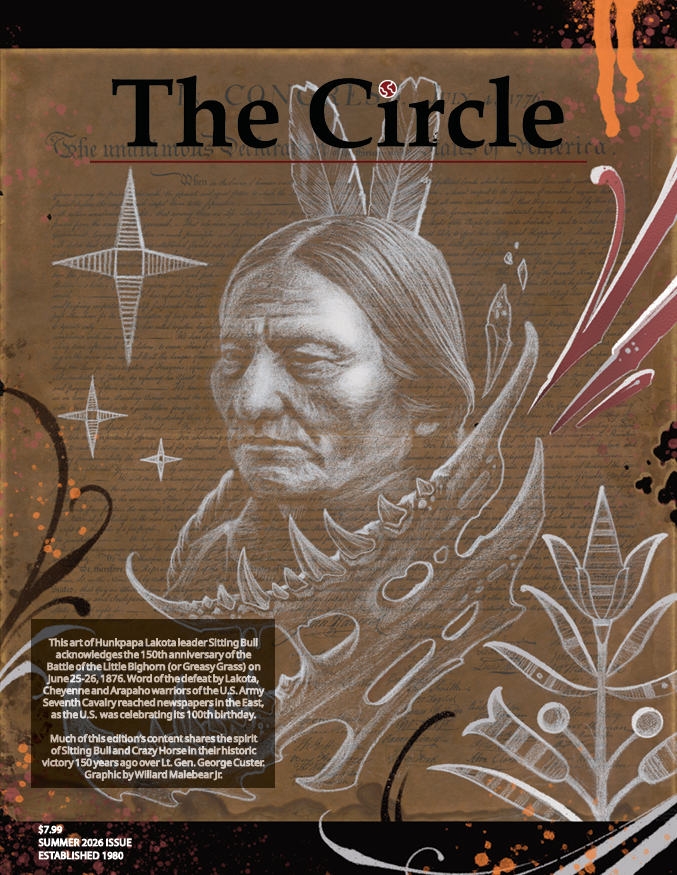
I am a proponent of an independent mind, and that First Amendment is worth fighting for. Many minds bring together great thoughts, which is how civilizations prosper. I think that Chief Sitting Bull’s quote (which graces the opening page of Rethinking Columbus) may be the best comment yet: "Let us put our heads together and see what life we will make for our children." That is, indeed, good counsel.