
 When the topic of Education and Native
Americans is brought up the view of a unsettling and disturbing
history plays with a sequence of historical trauma. This isn’t a
collaboration that was arranged with open arms and satisfying
results.
This approach began with Carlisle
Indian School, which was established by Gen. Richard Henry Pratt in
1879. Specifically built for Native American children, the approach
to this was to assist the Natives in becoming “civilized” and
functional in mainstream western society. However, teaching
arithmetic, writing and reading came with horrendous atrocities,
abuse and discipline within the Native boarding school systems that
would shape and change the classroom and generations forever.
To enhance any teachings the official
government policy was to, “Kill the Indian and save the man.”
With this motto came severe forms of discipline which included
beating, torture, sexual abuse and even death. Though Native people
wanted their children to be able to survive in the inevitable change
coming, they were not prepared to take on what the boarding school
system would bring. This created generational poverty among those who
endured, survived and would speak about it.
Since that dark period in tribal
history, Native people have a come a long way in developing and
tailoring education that meets the needs of their children. Students
have become educated, speaking fluent English and are encouraged to
learn their tribal history. Those who pursue a career in education
are are protected by policies, procedures and laws developed to
enshrine education that was once banned in boarding schools.
One such educator is Sage Fast Dog,
Sr., an enrolled member of the Rosebud Sioux Tribe in South Dakota.
He has taught in the Todd County School District, a non-Native public
school with a majority of Native students who attend, for nine years.
He graduated from St. Francis Indian
School – another school on the Rosebud reservation that caters
specifically to enrolled students – went onto college at Black
Hills State University in Spearfish, S.D. He finished his education
at Sinte Gleska University, the tribe’s own institution of higher
learning established in 1970, with a bachelor’s degree in Social
Studies and Lakota Studies. After being certified in Secondary
Education, he began teaching Lakota Studies at Todd County.
Fast Dog lives a drug- and
alcohol-free life with his wife Krista White, two sons, Sage, Jr.,
Waciyapi and newborn daughter Wacekiya. In a place where drug and
alcohol abuse are commonplace, it can be a challenge. But the father
and educator draws strength from his traditional values and
practices, singing with his family drum group, Soldier Creek. He is
also a traditional dancer in the powwow circuit and participates in
traditional Lakota ceremonies.
living the principles of Wolakota, Fast Dog is the Sicangu Club
advisor and helps coach the hand game team at the high school and
advises the drum group at Todd County Middle School.
With the many hats Fast Dog wears, he
talks to his students about what it’s like to teach history and
culture in what he calls “the iGeneration” where knowing what
happened a thousand years ago can be seen at the touch of a button.
To be a educator in todays society is
an exciting task. Educators have access to technology and research
enhancement like never before. As Native students enter the classroom
to learn about their history, culture and language they are reminded
of how far they’ve come, as a people who endured broken treaties
and surfing into a millennium on iPads.
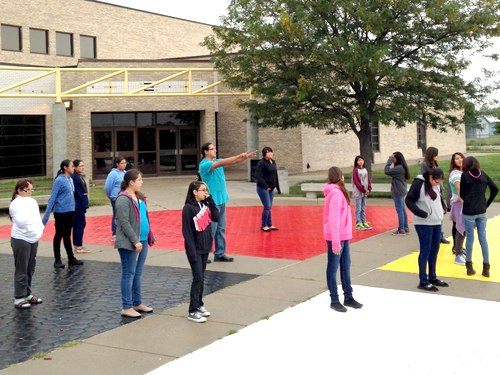
PHOTO: Sage Fast Dog, Sr., uses the architecture of St. Francis Indian School to explain to a group of students the basic principles of Wolakota. (Photo by Lynette White Hat)