


By Daltyn Lofstrom / Inforum
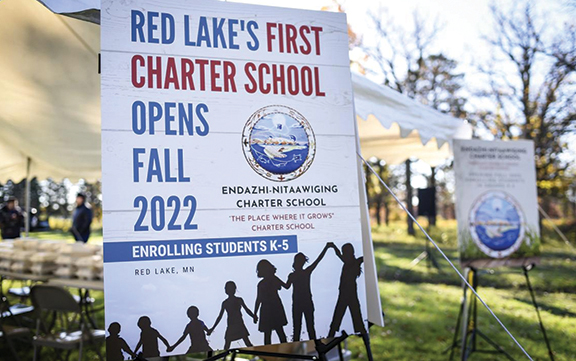
Spirits were high the morning of October 18 as around 50 members of the Red Lake community, tribal council and state politicians took part in the groundbreaking of the Endazhi-Nitaawiging charter school set to open in Red Lake in fall 2022.
“It’s a special day for us in Red Lake. This charter school has been a dream and I do see, one day soon, that (the school) will be a reality,” Red Lake Tribal Treasurer Annette Johnson said prior to the groundbreaking.
The council, in collaboration with the Native American Community Academy Inspired Schools Network (NISN), set forth to build a school grounded in Ojibwe values as a way to immerse younger students in Indigenous knowledge and culture.
The Endazhi-Nitaawiging, or “the place where it grows,” charter school will abide by the mission “to prepare each student for college with an enhanced knowledge of the Ojibwe language, culture, leadership and environmental stewardship.”
Its vision statement aims to “create confident leaders grounded in their true inherent identities and to ensure that they are academically, socially and spiritually prepared to positively change the community and world.”
NISN fellow Nathaniel Taylor, also a member of the Red Lake Nation, shared that the Anishinaabeg Indigenous people did not separate themselves from the land known as Mother Earth and that indigenized education is the restoration of who they are to the places they call home.
Using indigenized education and culture revitalization/preservation as its two core values, Taylor detailed the excitement of this new development and what it means to the Red Lake Nation and other tribal nations.
“The day is here where we no longer have to hide using (the Ojibwe) language,” Taylor said. “The day is here where we hold our chests up with pride and embrace who we are, our core identity. The day is here where we know our ancestors are smiling down on us for what we are doing, for how we are going to carry ourselves into the future, and giving our children the true essence of who they are once again.
“The day is here where we can share the creator’s love in our true original fashion for the plant world, the animal world, the star world. The original story can be, and will be, told again.”
A traditional Ojibwe creation story inspired the future school’s logo, a turtle with a piece of earth on its back. Following a flood, some earth was placed on a turtle’s back which then spun it around until it became the present-day United States.
“We are taking the school representing a turtle’s back and a plant representing our original self,” Taylor said. “We are going to place it on a turtle’s back and as a community, we’re going to help it grow.”
The school is set to open for grades K-5 and will expand to include an additional grade each year until the 2025-26 school year, the point at which the school would remain open to grades K-8.
“We need something for those little ones,” self-described “grandma of the school” Elizabeth Kingbird said. “When we were growing up, we were talking Indian all the time and then (teachers) would spank us in school for talking like that. Sometimes, they would put tape on our mouths.”
This school could be seen as a way of removing that tape as Kingbird mentioned, “I’d like to see that person now, spank her and put tape on her mouth so she wouldn’t say anything anymore to me,” which was met by applause and laughter from the attendees.
Anpao Duta Flying Earth from NISN echoed Kingbird’s sentiments stating that “we’re in a time now where school is no longer done to us, but by us.”
Flying Earth helped start a school in Albuquerque, New Mexico, with the idea that culture and language would not be separate from academics. After discussion with a community member, they used the adage, “don’t teach me about my culture, use my culture to teach me” to create the NACA Inspired Schools Network which currently has nine other schools in its network.
President of Red Lake Nation College and Hereditary Chief Dan King highlighted disparities regarding Indigenous education and that the average student starts out at RLNC at a ninth-grade level.
“We try to catch (these students) up by their junior year of college,” King said. “That’s our challenge. Here at the reservations, (developing prepared students) starts at the very beginning at this school.”
Discussions with the council involved whether to do an immersion at the high school level, though it was deemed more necessary for elementary students to create a firm foundation of Indigenous knowledge.

Independence and healing
With Endazhi-Nitaawiging on the horizon, King hopes to someday achieve “educational sovereignty,” or control over children’s education that addresses a unique culture, identity and language.
King also detailed growing a permanent educational fund to an eventual goal of $260 million, the point at which he described as “financial sovereignty.”
The ideas of independence and healing were a common thread throughout the morning speeches and meal, which both followed a sunrise ceremony.
Founding board member Alex Kmett described his experience of not growing up with the Ojibwe language following his grandma, originally from Ponemah, losing the language when she attended Red Lake schools.
“Years and years later, I set out to pick up the language myself,” Kmett said. “It’s been a big part of my personal healing, helps me straighten out my own life and gives me a lot more perspective for how I understand and approach the world through the Ojibwe language.”
Kmett said he is now raising his 2-year-old daughter using only Ojibwe.
Reprinted with permission from https://www.inforum.com.