

By Lee Egerstrom
The familiar warning sign, “Slippery When Wet,” isn’t just for highways, exit ramps and overpasses anymore.
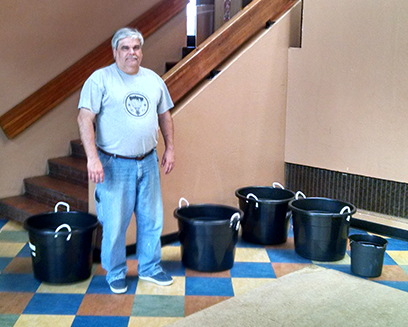
The Minneapolis American Indian Center has warnings on the stairwell to the lower level of the center where large utility buckets are tucked around the stairs on dry days and placed on various parts of the floor when it is raining.
“When it rains outside, it rains inside,” said Mary LaGarde, executive director at the Minneapolis center. “Our roof has to be a priority.”
Minneapolis American Indian Center (MAIC) was one of several projects included for funding in the State Bonding Bill that passed the Minnesota Legislature late in its session. Most items in the $1.4 billion bill will impact all Minnesotans, including Natives living in the state; and jobs created by the public investment package will also benefit Native workers.
Some items, however, are keyed especially for the Native American community in Minnesota or will promote the Native culture.
Included among them is a $5 million grant for MAIC – or roughly a third of the money needed for a $15.2 million plan to modernize and expand the center, 1530 E. Franklin Ave., in the heart of Minneapolis’ American Indian Cultural Corridor.
LeGarde said MAIC officials are readying plans to start a capital formation drive for this fall. They are also seeking legal clearances on when and how it can use the state grant to start repair or replacement work on the roof.
Brian Joyce, program director for the Native Fitness and Nutrition program at MAIC, pointed to a light hanging from the third floor ceiling that is directly under a seam of wood ceiling planks and a glass skylight. Rain water pours through, he said, making a cascade shower over the light fixture and splashing water down onto the floor and into buckets placed below.
“It looks like we have a water fountain in here until you see where the water is going,” he said.
Gov. Mark Dayton singed the bonding bill into law on May 30. MAIC is meeting with supportive lawmakers to determine how much of the remaining planned improvement project’s cost might be sought in future bonding bills.
Several other major projects within the 2018 bill addressed issues and problems dear to American Indian people.
They included $14 million for the Red Lake Elementary and Early Childhood Center at Red Lake, $3 million to the city of St. Paul for continued development of the Wakan Tipi Center in the Bruce Vento Nature Sanctuary on St. Paul’s East Side, $1,157,000 in renovation funds for the Fond du Lac Tribal and Community College, and $900,000 for the White Earth Nation’s Opioid Center.
In reverse order, the latter addresses a serious health crisis across much of Minnesota. The grant will be made through the Minnesota Department of Human Services. The Fond du Lac grant, however, comes through the colleges’ affiliation with the Minnesota State Colleges and Universities System (MnSCU).
Melinda Crowley, superintendent of Red Lake Public Schools, said in a memo to the district’s school board, faculty and staff the $14 million Red Lake grant will allow renovations of existing spaces and add classrooms to the Elementary School and Early Childhood complex.
In the statement, also released to media, Crowley noted Red Lake enrollment is increasing form 3 to 4 percent per year and that additional space is needed. The project will allow construction of a connection between the elementary school and Early Childhood Center, plus larger space for food service for the 793 students.
In addition, the project will provide for renovation of music and art classroom, computer lab and students support area spaces.
Echoing concerns from all across America, Crowley said the project will add to safety by creating a central entrance for students and the public and create separate family drop off and bus loading areas.
Construction is estimated to be conducted between June 2019 and August 2021.
The $3 million grant for the Lower East Side project in St. Paul, however, is a direct acknowledgement of the early Dakota settlements that later became St. Paul and will anchor the Dakota culture even as it explains to newer generations and tourists all the ethnic groups that called the East Side home.
It will be used to build the Wakan Tipi Center (“House of Spirits” or “Dwelling of the Sacred”) that will serve as the interpretive center for the Bruce Vento Nature Sanctuary. It will honor the nearby Wakan Tipi Cave as a sacred site even as it links for educational purposes the natural, cultural and historic background of St. Paul’s East Side and Lowertown neighborhoods.
The city will own the building while the developer, the Lower Phalen Creek project, will operate the center under a long-term lease agreement.
Melanie Kleiss, executive director for the project organization, said the center will be a home base within the 27-acre Bruce Vento Nature Sanctuary. It is also a converging and starting point for people wanting to use 100 miles of connected trails.
Fundraising continues for the entire $6.7 million Lower Phalen Creek Project, Kleiss said. Construction of the Wakan Tipi Center, however, is still more than a year away.