

By Lee Egerstrom
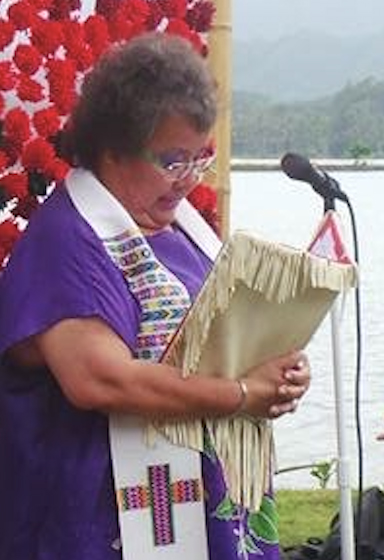
The Rev. Marlene Whiterabbit Helgemo and members of the All Nations Indian Church in south Minneapolis are finding crafty, high-tech ways to stay connected and comfort one another while the COVID-19 pandemic keeps them physically apart.
“We’re getting good at ‘Zooming’,” Helgemo said. “We Zoom it.”
In the two-plus months since churches and other gathering places were shut down to protect against the virus, churches turned to technology to keep people connected.
All Nations Indian Church, 1515 E. 23rd St., uses Zoom “videotelephony,” also called teleconferencing technology, to connect people for Sunday services and for Wednesday night chat sessions.
The Wednesday chats are important, she said. Five of the congregants are front line essential workers in danger of becoming inflicted. One works in an intensive care unit (ICU) at a hospital, another in an emergency unit, two work at health clinics, and one is a pharmacist at a veterans’ hospital.
“It’s important that we comfort them, tell them that we love them, and that we are praying they stay healthy and safe,” she said.
Seeing each other when in a teleconference setting does lift spirits for the participants, Helgemo added. Everyone feels stress in these times; some will discuss their personal problems, and others seem to gain strength just by seeing and talking to friends.
One lady recently set the stage for that, Helgemo said. “She said right at the start, ‘Let’s just talk about happy stuff tonight.’ That’s what we did.”
In the weeks ahead, All Nations may consider restarting Sunday services at the church depending on what transpires with the pandemic and on guidance from Minnesota health professionals and state officials.
One reason for optimism is that All Nations often holds outdoor services during the summer months, gathered around a fire. That offers a better option for social distancing than in an indoor church sanctuary.
For readers unfamiliar with teleconferencing technology, Zoom conferences connect people on computers, smart phones and other devices, visually and voice. Until the COVID-19 hit, this service from Zoom Video Communications in San Jose, Cal., was primarily used by businesses and tech-savvy younger people.
Helgemo said her elder church members and friends “have been on a fast learning curve” the past two months. She and others have helped people get proper equipment and have walked them through the process of getting connected.
People with computers were fairly easy to get online, she said. Computer cameras are at face level and that works fine when joining a Zoom conference. People with hand-held devices, however, have needed extra coaching such as how to hold their device in front of their face.
(Laughter.) “You don’t want to be looking up people’s noses.”
A positive that seems to be coming out of the COVID scare is that people are pausing to appreciate families and friends, she said. Telephone conversations, mailing cards to loved ones, and routinely checking on each other and their needs seem more common now than before.
One unfortunate and painful problem for her ministry, however, is the inability of gather people together for funerals. Funerals get delayed. Friends and families can’t gather for “meals, hugs and conversation to help with grieving,” she said. Some attempts to do funerals on Zoom and other teleconferencing technology have been attempted, but there have been problems getting everyone connected.
Helgemo, a member of the Ho-Chunk Tribe in Wisconsin, gets a lot of practice with technology conferencing. She is active in several organizations that require conference calls, Facebook communications, constant emails and nearly every technology useable for communications.
An ordained Lutheran minister serving as pastor for All Nations Indian Church of the United Church of Christ, she is a past president of the Minneapolis Council of Churches. She served on Ho-Chunk boards and for the Native American Community Development Institute, is a member of the Augsburg University Board of Regents, and is currently the president on the board of the American Indian Community Development Corp. (AICDC).