

By Lee Egerstrom
Native people wanting to shake loose from commercial tobacco addition now have a new tool to help them through the modern technology of text messaging.
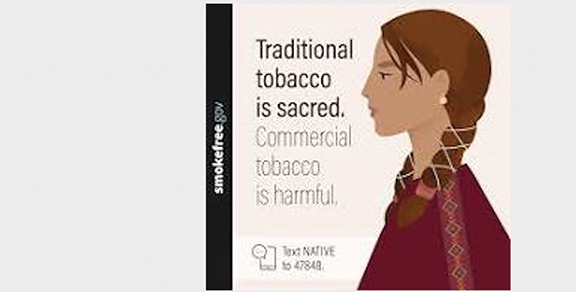
The National Cancer Institute (NCI) and the Indian Health Service (IHC) announced late last year they have started a free text messaging program called SmokefreeNATIVE. It was specifically designed to help American Indian and Alaska Natives (AI/ANs) quit commercial tobacco while still honoring the cultural importance of their traditional tobacco.
This program can be accessed on the Internet by SmokefreeNATIVE or by texting NATIVE to 47848.
It should have a “down home” feel for many Minnesota Indigenous people. The announcement of the program said the St. Paul-based American Indian Cancer Foundation (AICAF) worked with the University of Minnesota School of Public Health to support NCI and IHS in developing the program.
The Foundation said it was an effort “to create a culturally aligned digital resource to improve access to evidence-based smoking cessation support for AI/ANs.” It also teams with actions federal agencies are taking as part of the White House Cancer Moonshot effort.
The SmokefreeNATIVE program is designed for people ready to quit smoking commercial tobacco and are willing to set a quit smoking target date. The texting program then offers six to eight weeks of texting materials with smoking cessation themes and content on Native cultural experiences, worldviews and traditions, the announcement said.
The AICAF statement thanked organizations “that have played a pivotal role in achieving this significant milestone, making the journey to quit commercial tobacco more accessible to our relatives across Indian Country.”
It comes after health officials have documented substantial evidence that smoking related health problems are greatest among Indigenous people.
Alberta Becenti, a Dine from New Mexico who works as a public health advisor and disease prevention expert with IHS in Washington, D.C., said in a Dec. 14 statement:
“People who smoke cigarettes are at risk for many adverse health effects, including cancer, chronic obstructive pulmonary disease, cardiovascular disease, and poor reproductive health outcomes. On average, American Indians and Alaska Native people have the highest prevalence of cigarette smoking compared to all other racial and ethnic groups in the United States.”
As a result, she said, “Heart disease, cancer and stroke are leading causes of death in these communities.”
Health officials across the nation observe the higher use of commercial tobacco products by Indigenous Americans, and it was carefully documented in a 2017 National Health Interview Survey. Results of that survey found nearly one in five adult Americans still use commercial tobacco products, but nearly 30 percent of AI/AN adults do.
The findings of survey results were published by the Centers for Disease Control (CDC), the Food and Drug Administration (FDA) and the NIC’s National Cancer Institute in 2018. They found 47.4 million U.S. adults (and estimated 19.3 percent) were daily users of tobacco products.
For ethnic groups, however, the researchers found AI/AN adults had the highest daily use of tobacco, at 29.8 percent. Cigarettes accounted for 20.6 percent of the usage.
Two other findings from the survey also have implications for the Indigenous communities in and around Minnesota.
The second highest ethnic group of users (27.4 percent) was a category called Mixed Race, Non-Hispanic that likely include a sizeable number of Native relatives, especially in urban areas. And, the highest percent of tobacco users measured by Census regional areas was found in the Midwest region (23.5 percent), not in the South and regions where most commercial tobacco is grown and where prices for tobacco products are the lowest in the U.S.
The national AICAF foundation has several programs, including a Scared Breath campaign, to help people and their loved ones cope with tobacco-related cancer and in finding appropriate care and treatment.
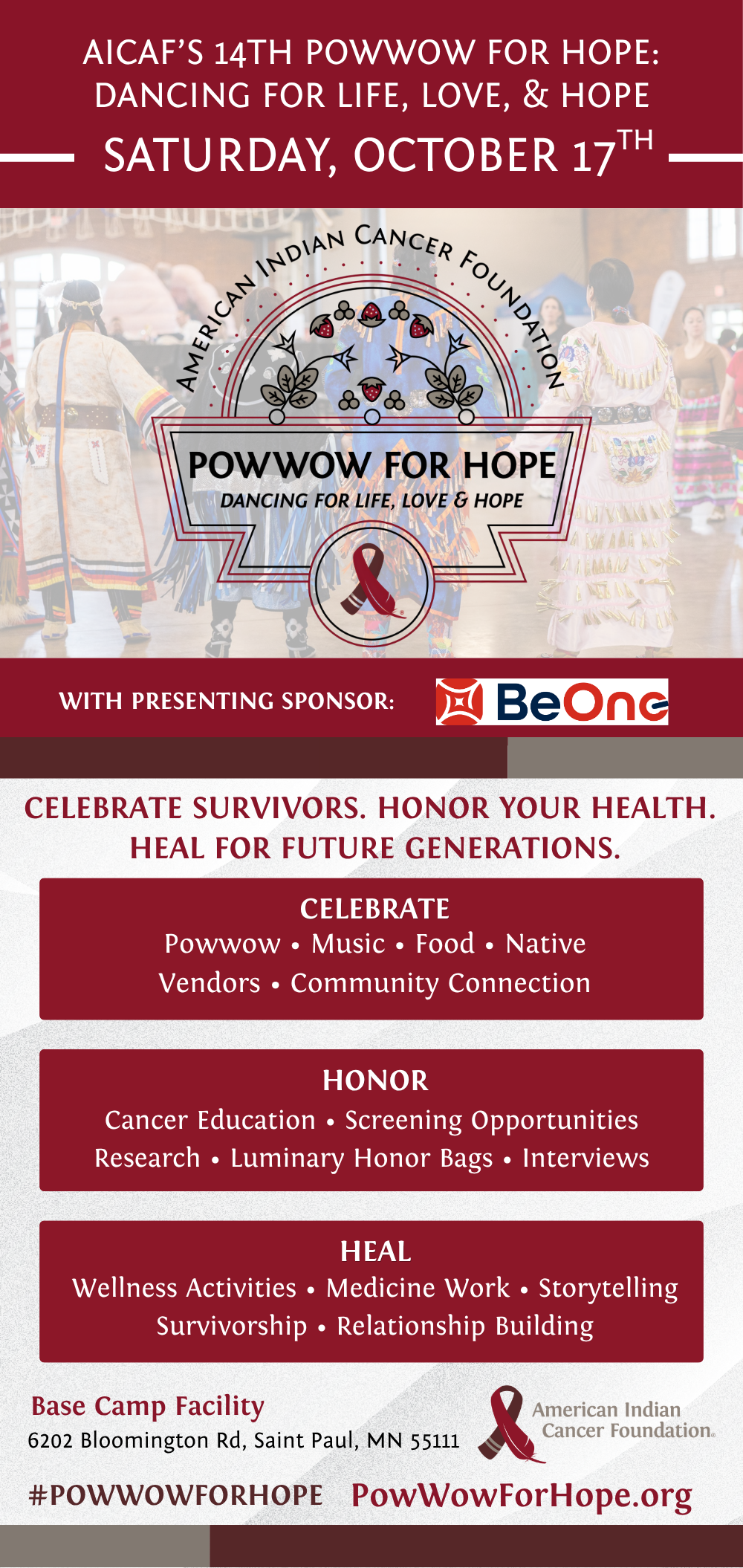
In support of these efforts, it also has events in different locations that include the annual Powwow for Hope, set for May 4 this year in St. Paul; and another Roc Your Mocs round dance and powwow in Chicago.
For more information on the new program and for other helpful information, see:The American Indian Cancer Foundation at www.aicaf.org; SmokefreeNATIVE at Indian Health Service at https://www.ihs.gov;
and the White House Cancer Moonshot at https://www.whitehouse.gov/cancermoonshot.