
 An analysis released May 28 by the
American Civil Liberties Union gives the most detailed picture yet of
racial disparities in the treatment of low-level offenders by
Minneapolis police.
Those arrested for non-felony offenses
in Minneapolis are far more likely to be people of color than to be
white.
The ACLU analyzed arrest data collected
over nearly three years. Most of the arrests for low-level offenses
occurred during traffic stops. Following FBI practice, the ACLU
counts as an arrest encounters where people are merely stopped,
ticketed and released.
Minneapolis police officers made nearly
100,000 non-felony arrests between Jan. 1, 2012, and Sept. 30, 2014.
African-Americans and Native Americans were arrested at rates nearly
nine times higher than the rate for whites.
African-Americans make up less than 19
percent of the city’s population, and Native Americans just 2
percent. The arrest numbers don’t include separate categories for
Asians and Hispanics.
The disparity didn’t come as a surprise
to Henry Jackson, 55, as he stood across the street from Target Field
with a handful of tickets.
Buying and selling tickets is legal,
but Jackson, who’s African-American, has been arrested for
trespassing in the neighborhood three times since 2012.
The latest arrest happened outside
nearby Target Center in January, as he was selling tickets for a
Timberwolves game. He had stepped inside Target Center to warm his
hands, he said, when two police officers cited and released him.
Jackson said white ticket sellers could
do the same thing "all day long" without being stopped,
"but it seems like they got us singled out."
Jackson was convicted, ordered to pay a
$50 fine and given a stayed sentence of 90 days in the workhouse on
the condition that he stay out of Target Center for a year. Now he
can’t enter the venue, even as a paying customer.
An MPR News analysis of the same data
the ACLU examined found more than half the people arrested for
trespassing were black.
The ACLU report comes at a time of
intense national discussion about race, police and inequality.
Minnesota ACLU Executive Director Chuck
Samuelson sees several reasons for the disparities in Minneapolis
arrests. He blamed bias among police and among people who call the
police when they see someone they think looks suspicious.
Samuelson said the disparities also
result from policies that focus enforcement in neighborhoods with
large minority populations. The result, he said, is "just
shameful."
"We’re better than this," he
said. "We need to be better than this. And there’s no reason why
we can’t be better than this."
Samuelson said the new study is much
more detailed than an analysis the ACLU released last fall. That
report found Minneapolis had the country’s third-highest disparity in
marijuana arrest rates for African-Americans and whites.
The ACLU study found black children
made up the majority of juvenile arrests. And 88 percent of children
between the ages of 4 and 12 arrested for violating curfew were
children of color.
The new report comes on the heels of
two studies of police data released recently by the city of
Minneapolis. One found that officers rarely record the race of
people they detain but don’t arrest. The other found that whites
were more likely to call police to report black people suspected
of committing non-felony crimes like loitering.
Most people arrested were not booked
and jailed. Instead, they were given citations and ordered to go to
court.
On a recent Monday morning, dozens of
people sat quietly in one courtroom. A dozen or so waited outside in
the lobby. Nearly all of them were people of color.
"Usually they’re in court for an
entire morning," said Melissa Fraser, assistant Hennepin County
public defender.
Many people choose to plead guilty to
the offenses, Fraser said. They’ve already had to take time off work
or get child care while they wait. Fighting a charge, she said, will
bring more days of waiting in courtrooms.
Pleading guilty may bring a faster
resolution, but it can mean trouble down the road.
"If you have a disorderly conduct
conviction, that can create problems when you want to rent an
apartment, or obviously for jobs," she said.
And the need to get a job, explained
Police Chief Janeé Harteau, can lead to trouble as well.
Between 2010 and 2014, she said, one in
six drivers stopped by Minneapolis police lacked a driver’s license.
One reason, she said, is that behind-the-wheel testing sites are all
outside the city and can be hard for poor city residents to get to.
"And they need a driver’s license
to get a job," she said. "They can’t get a job because they
can’t get there. Or they get stopped because of a traffic violation
on the way to their job without a driver’s license. Now they’ve got a
misdemeanor on their arrest record."
Such traffic-related offenses accounted
for most of the arrests. The most common was driving with a revoked
driver’s license. MPR News found that nearly three-quarters of people
arrested for driving with a revoked license were African-American.
The ACLU study also addressed the
relationship between policing and poverty. The data show police
arrested homeless people more than 6,000 times during the 33 month
period.
Harteau acknowledged that police
presence is higher in areas with more violent crime. And those
neighborhoods tend to have large populations of poor people of color.
"And so it’s not surprising to me
that you’re going to have lower level offenses at a higher rate"
in those areas, she said.
Harteau said her department is making
strides toward reducing the tensions between communities of color and
the police. She recently asked for a federal audit of her
department’s disciplinary system.
Policy changes are also in the works.
The City Council’s Public Safety Committee has voted to repeal laws
against spitting on the sidewalk and lurking, laws that critics say
have been used to unfairly target people of color.
Samuelson, the Minnesota ACLU executive
director, said pressure from activists, as well as cooperation from
elected and police leaders, can all help eliminate racial
disparities.
"But we’ve got to be really
willing to try," he said. "And I have a sense that maybe,
just maybe, that’s starting."
The City Council will vote on the
proposal to repeal laws against lurking and spitting next week.
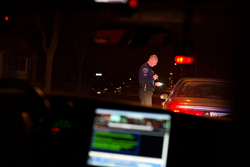
PHOTO: Minneapolis police Sgt. Jeff
Carter stopped a suspicious vehicle Thursday night, March 12, 2015,
in north Minneapolis. (Photo by Jennifer Simonson | MPR News file)
Minnesota Public Radio News can be heard on MPR’s statewide radio network or online.