


By Lee Egerstrom
The recently reopened Gatherings Café at the Minneapolis American Indian Center is a reconnection for the center with the explosive Indigenous food scene in Minnesota that is especially hot in Minneapolis.
The café was closed during the MAIC’s massive and recently completed expansion and remodeling project. It reopened in late June with a limited schedule.
But visitors are already finding the Gatherings’ phased in approach is serving up memorable food experiences. That was again displayed in July when executive chef Vernon DeFoe displayed his talents with a menu tasting for journalists.
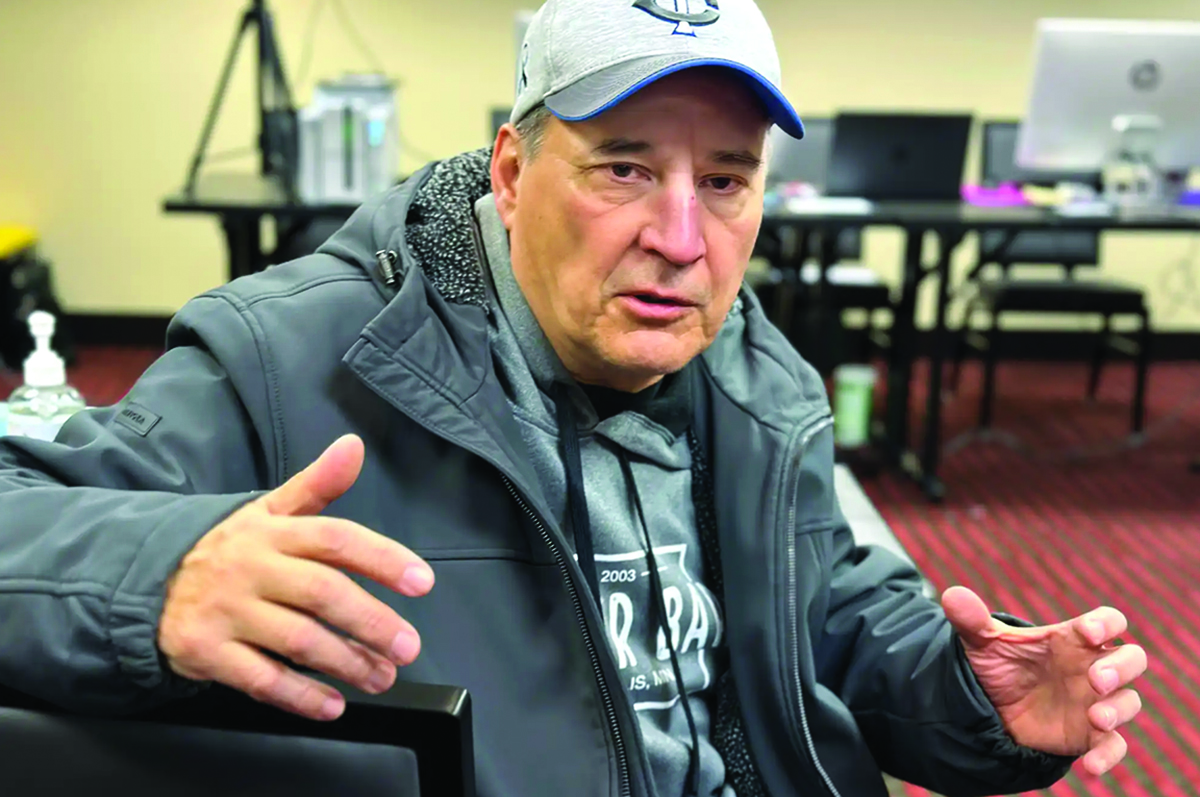
DeFoe (Red Cliff Anishinaabe) joined Gatherings this past October during the remodeling that moved the café into expanded Franklin Ave. street front space. He has more than two decades of restaurant experience that started with highly awarded Sean Sherman and The Sioux Chef.
As the MAIC describes it, “Under Vernon’s leadership, the café reopened with an expanded team, kitchen, and dining space, increasing its capacity to serve healthy, accessible, Indigenous meals. The café focuses on food native to Turtle Island, combining innovation with ancestral knowledge.”
The tasting offered samples of cedar maple tea, wild rice pancakes, a “root veggie hash,” turkey sausage, “Three Sisters Kale Salad,” hominy cakes, a bison or veggie melt, and for dessert, chia seed pudding.
Breakfasts are served to the public from 8 a.m. to noon, priced between $7 for a breakfast sandwich of egg, roasted pepper aioli and cheese and on up to $15 for The Good Way breakfast of scrambled eggs, bison, jalapeno pepper and smoked Gouda cheese.
Other main breakfast offerings include variations of scrambled eggs, wild rice, turkey sausage, pancakes, berries, beans, toast, and with a la carte offerings of greens, fruit, vegetable hash and the oh-so Indigenous maple syrup and Wojapi fruit sauce.
Wojapi can be made with any number of Indigenous fruits. Hereabouts, and at DeFoe’s kitchen, it is made the Lakota/Dakota way with root flour and chokecherries.
Lunches are more extensive with bison, fish, turkey, vegetable melts, salads, seasonal offerings, and bison and grilled veggie tacos.
If readers pause for a moment, it should become obvious that core elements in the Gatherings’ menu are anchored in what tribal ancestors knew for millennium. Healthy eating practices and food preparation are connects. So are harvesting native food items from both foraging (nuts, berries and wild rice) and farming (corn, beans and squash), along with harvesting protein sources (meats and fish) from plains, forests, lakes and streams are all connected.
This is increasingly recognized globally through various United Nations units and multilateral agencies such as the World Food Programme and UN Food and Agriculture Organization.
Awareness is increasing here in Upper Midwest states and adjoining provinces of Canada. It is owing in no small part to the work of groups such as the Indigenous Food Lab (see adjourning article) based in Minneapolis.
Defoe studied and worked at the Indigenous Food Lab before sliding over to Gatherings Café.
Readers on the MAIC’s website should scroll down from the Gatherings Café menu to find two video presentations of DeFoe preparing wild rice turkey meatballs and chia seed pudding. The latter, he points out, can serve as either a dessert or a breakfast cup item.
The menu, for customers, and DeFoe’s videos answer an age-old misinterpretation. Eating healthy and indigenous foods does not come from sacrificing taste. Well prepared Indigenous food can also be gourmet fare.
The videos are presented by a MAIC program that supports and strengthens the urban Native community Native and non-Native people far and wide through the Internet.
The center’s Culture Language Arts Network (CLAN) has programs utilizing Dakota and Ojibwe languages while teaching young people technology skills. CLAN sees this as a tool to help American Indian youth, adults, and families participate in cultural activities.
Among those programs are adult language classes and the youth language, technology and cultural projects. It also has programs for powwows, drum and dance, podcasts and a film and art festival.
Another program is the Tradish Project. MIAC describes it as a project promoting “the joy of traditional dance by fostering a positive cultural identify and community strength while combating obesity, heart disease and diabetes.”
These activities include weekly traditional dance, teaching circles for dance styles, stories and songs; powwow aerobics for teens and adults, and a sewing circle for elders to create regalia for young dancers.
Indigenous food is totally entwined with MIAC’s focus on community health and tradition.
Defoe combines his interest in hiking, foraging for native foods such as nuts and berries, wildlife, botany and geology with his work with Indigenous foods, including teaching and demonstrating to others how to prepare these foods at home.
This has him working with MAIC’s elder and fitness programs giving demonstrations and preparing meals for elders. His food demonstrations for those programs help people prepare healthier meals at home and aim to reduce “negative health outcomes” within the Native American community.
Another unit at MAIC, the Native Fitness and Nutrition (FAN) program offers activities and educational resources to fight health disparities in the American Indian community. Its Native Elders Support Team provides services and activities for local elders. This ties in with MAIC’s fitness center and gym used for exercise and community activities.
FAN’s programs returned to the new MAIC in May after working from other sites during the center’s renovation
Tying healthy foods with healthy living is no small task for a unique restaurant that remains a comparatively small enterprise by commercial eatery measurements. Diverse objectives are also revealed by special staffing needs.
Sydney Ockenga was recently appointed café manager to work in tandem with the executive chef and kitchen crew. Star LaDeaux (Sisseton Wahpeton Oyate) has the title of executive assistant and Gatherings Café Grants Manager.
Not many – if any – urban restaurants have a ‘grants manager.’ MAIC explains that by noting part of Gatherings’ budget is handled by restaurant operating revenue. But given its multiple objectives and educational work, the restaurant and food operations also rely on outside grants.
Actual menu offerings can be found at https://www.maicnet.org/gatherings-cafe.
For more information on how healthy living and healthy Native foods combine with Indigenous culture, check out various programs at MAIC at http://www.maicnet.org.